Search for "Schulte table" and you'll find plenty of apps promising it will make you read dramatically faster through better peripheral vision. Some of them cite specific numbers. Almost none of them cite a source. This article covers where the exercise actually comes from, what's genuinely well documented about it, and where the marketing claims run ahead of the research.
Where the Schulte table actually comes from
A Schulte table is a grid of randomly placed numbers or letters. You fix your eyes on the center and try to locate every item in order using peripheral vision alone, without letting your eyes wander across the grid. It wasn't invented as a reading tool: it was developed by German psychiatrist Walter Schulte (1910–1972), who used it during his work at the University of Tübingen as a psycho-diagnostic test for studying attention and visual search speed in a clinical setting.[1]
From there it was picked up outside clinical psychology, most notably in Soviet and Russian-tradition speed-reading pedagogy, as a concentration and visual-scanning drill. That's the lineage worth knowing: an attention test that got repurposed as a training exercise, not something originally designed to teach reading.
What it plausibly trains: attention and visual search speed
The task itself (holding steady focus on a center point while your peripheral vision does the searching) exercises two things each individually well supported by psychology research: sustained attention (staying locked on a task without your focus drifting) and visual search speed (how quickly you can locate a target among distractors). Regular Schulte table practice is a reasonable way to drill both.
This matches what the app itself measures: work efficiency, "warming up" time, and psychological stability across sessions, tracked in the statistics screen as you practice. Those are attention and consistency metrics, a fair, honest description of what the exercise is actually doing.
What the science doesn't support: faster reading via peripheral vision
Here's where it's worth being careful. The specific claim made by a lot of Schulte-table apps and speed-reading courses, that training your peripheral vision lets you take in more text per glance and read meaningfully faster, runs into a well-established finding in reading research: peripheral vision during reading is inherently blurry and imprecise, not something that sharpens with grid practice, and there's a direct trade-off between reading speed and comprehension. A peer-reviewed review of decades of reading research, published in Psychological Science in the Public Interest, concluded that claimed shortcuts to faster reading through techniques like this lack real scientific support, and that the modest gains people do see come from plain practice and vocabulary familiarity, not a special technique.[2]
You'll come across sites advertising specific figures, something like "increases reading speed by 28 to 35 percent," with no study cited behind the number. Treat claims like that as marketing, not evidence. The honest version is narrower: Schulte table practice is a solid attention and visual-search drill, and a habit of consistent reading practice (with or without a grid) is what actually moves reading speed, gradually and modestly.
Putting it into practice
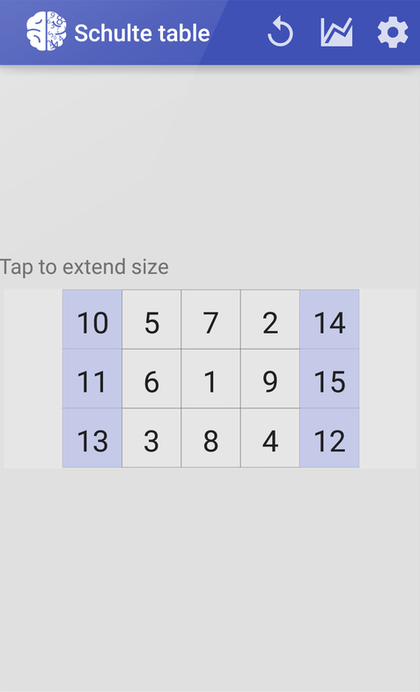
Schulte Table Game applies the exercise across grid sizes from 3×3 up to 7×7 (11×11 in the full version), in two modes: Time mode, where you clear the grid as fast as possible, and Training mode, which starts small and grows the grid with each tap so you build up gradually. Several color schemes and a highlighted center point are available to help you stay focused, and a statistics screen logs your results over time.


▶ Download Free on Google Play
See all grid sizes, color schemes and the full screenshot set on the Schulte Table Game page.
Sources
[1] Schulte table, HandWiki (mirrors the original Wikipedia article on this topic, which has since been removed; origin and clinical use)
[2] So Much to Read, So Little Time, Association for Psychological Science (Rayner et al., 2016, peer-reviewed review of reading-speed research)